The Cap City Liberty blog has moved!
You can now find the most recent Wisconsin civil liberties news and opinion from the ACLU of Wisconsin on our brand new website: www.aclu-wi.org. The Cap City Liberty blog now
lives with other information such as how to become a member of the ACLU
of Wisconsin, what kinds of community education programs we offer, and
the news from our legal department.
Supporting us has never been easier. Visit www.aclu-wi.org today to donate and keep our important watchdog efforts going.
Wednesday, September 26, 2012
Wednesday, August 10, 2011
Police Info Request on GPS Tracking in Wisconsin - Your Cell Phone Knows Where You Were Last Night . . . Who Else Does?
 This blog post by ACLU staffer Allie Boehm was originally posted on the national ACLU's Blog of Rights.
 On August 3, 34 ACLU affiliates filed 379 public records requests in 31 states around the nation, including in Wisconsin, to seek information about how our local law enforcement agencies are using our cell phone location information to track us.
Chances are you’re walking around with a tracking device in your purse or pocket – a cell phone. Location data from your cell phone can make it easy to get directions or locate the nearest coffee shop, leaving no doubt that your cell phone knows where you are. Even if you use a dumb phone, cell phones constantly send out signals searching for the nearest cell tower in order to make sure your calls actually go through – and companies can estimate your location based on your proximity to nearby towers with ever-improving accuracy. The amount of time they store this information, and in how much detail, depends on the cell phone provider. (Remember the public outrage over Apple’s surreptitious storage of iPhone and iPad user’s location information a few months ago?)
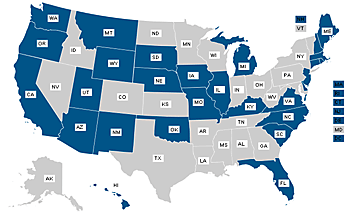 |
| Check out our interactive map to see what agencies we've requested records from in YOUR state! |
What’s revealed by this perpetual tracking can be intensely personal; as a court recently found, one’s location might reveal “whether he is a weekly church goer, a heavy drinker, a regular at the gym, an unfaithful husband, an outpatient receiving medical treatment, an associate of particular individuals or political groups — and not just one such fact about a person, but all such facts.”Okay, I hear you thinking, “Right, but I’m not a criminal. Why should I care?” Think again. Law enforcement’s use of cell phone location data has been widespread for years. In fact, just last week, Sen. Ron Wyden (D-Ore.) asked Matthew Olsen, current general counsel for the National Security Agency and President Obama’s nominee to head the National Counterterrorism Center, whether the government can use cell phone location data to track Americans in the United States. Olsen replied, “There are certain circumstances where that authority may exist.” Cagey much?
Here’s what we do know: in 2010, FBI agents investigating a series of bank robberies demanded the records of every cell phone that was near each bank when it was robbed. That same year, Michigan police officers sought information about every cell phone near the site of a planned labor protest.
You might be asking yourself, “how can they do this?” Our laws simply haven’t kept pace with new technology. Furthermore, while we believe that law enforcement should always be required to obtain a warrant based on probable cause to access cell phone location information, the scary truth is that they don’t always obtain said warrant, and courts don’t always insist that they do.
What’s more, much of this jurisprudence is shrouded in secrecy, leaving the public in the dark about when our location information is sought and under what standards. And you were wondering why we only had two examples.
In order to lift the veil on this secrecy – and uncover some more examples of when, why, and how law enforcement agencies are using our cell phone location data to track us – 34 ACLU affiliates are filing public records requests with 379 agencies seeking information including:
- whether law enforcement agents demonstrate probable cause and obtain a warrant to access cell phone location data;
- statistics on how frequently law enforcement agencies obtain cell phone location data;
- how much money law enforcement agencies spend tracking cell phones and
- other policies and procedures used for acquiring location data.
Supporting the Wyden/Chaffetz bill is just one way to Demand our dotRights -- we shouldn’t have to pay for our cell phones with our privacy rights.
You can read more about this nationwide info request in the LA Times or on Wisconsin Public Radio where the ACLU of Wisconsin was quoted on why GPS tracking is a matter of basic privacy concern. Stay tuned to the Cap City Liberty blog or follow us on Twitter @ACLUofWisconsin for updates as we learn more about police practices across the state.


Monday, August 8, 2011
Transgender People’s Right to Access Medical Treatment in Prison Upheld by Federal Court
The U.S. Court of Appeals for the Seventh Circuit today upheld the right of transgender people to receive medical care while they are incarcerated. The American Civil Liberties Union, the ACLU of Wisconsin and Lambda Legal had challenged a Wisconsin law that prohibited prison doctors from prescribing hormone treatment or sex reassignment surgery to transgender inmates.
“This was a discriminatory law that cruelly singled out transgender people by denying them – and only them – the medical care they need,” said John Knight, senior staff attorney with the ACLU Lesbian Gay Bisexual and Transgender Project. “Too often the medical needs of transgender persons are not treated as the serious health issues that they are. We are glad that the appeals court has found that medical professionals, not the Wisconsin legislature, should make medical decisions for inmates.”
The appeals court wrote: “Surely, had the Wisconsin legislature passed a law that DOC inmates with cancer must be treated only with therapy and pain killers, this court would have no trouble concluding that the law was unconstitutional. Refusing to provide effective treatment for a serious medical condition serves no valid penological purpose and amounts to torture.”
In 2005, the state of Wisconsin passed a law that barred prison doctors from providing transgender inmates medically necessary hormone therapy or sex reassignment surgery while in state custody. The ACLU, the ACLU of Wisconsin and Lambda Legal sued the state on behalf of transgender inmates, some of whom had been receiving hormone treatment in Wisconsin prisons for years. An injunction was granted to continue hormone treatment until a ruling was made. In April 2010, after a full trial, a federal district court struck down the so-called “Inmate Sex Change Prevention Act.”
“The court correctly ruled that denying prisoners medical treatment constitutes cruel and unusual punishment,” said Dru Levasseur, Lambda Legal’s transgender rights attorney. “The medical needs of transgender people don’t disappear once they enter prison. We’re glad that the court has ruled that the legislature cannot outlaw the only effective treatment for some people with Gender Identity Disorder.”
“This decision should make it abundantly clear that it is unconstitutional to deny transgender inmates hormone therapy and sex reassignment surgery absent a medical basis for doing so,” said Larry Dupuis, legal director of the ACLU of Wisconsin.
Read more about this case including the text of the court's decision on the American Civil Liberties Union Fields v. Smith case profile page or on Lambda Legal's case page.
Media coverage of the court victory included stories in the Wisconsin State Journal (AP wire stories ran in Chicago, the Twin Cities and other areas in the country), Milwaukee Journal Sentinel, the Advocate, the Wall Street Journal law blog and LGBT-related blogs around the country.
“This was a discriminatory law that cruelly singled out transgender people by denying them – and only them – the medical care they need,” said John Knight, senior staff attorney with the ACLU Lesbian Gay Bisexual and Transgender Project. “Too often the medical needs of transgender persons are not treated as the serious health issues that they are. We are glad that the appeals court has found that medical professionals, not the Wisconsin legislature, should make medical decisions for inmates.”
The appeals court wrote: “Surely, had the Wisconsin legislature passed a law that DOC inmates with cancer must be treated only with therapy and pain killers, this court would have no trouble concluding that the law was unconstitutional. Refusing to provide effective treatment for a serious medical condition serves no valid penological purpose and amounts to torture.”
In 2005, the state of Wisconsin passed a law that barred prison doctors from providing transgender inmates medically necessary hormone therapy or sex reassignment surgery while in state custody. The ACLU, the ACLU of Wisconsin and Lambda Legal sued the state on behalf of transgender inmates, some of whom had been receiving hormone treatment in Wisconsin prisons for years. An injunction was granted to continue hormone treatment until a ruling was made. In April 2010, after a full trial, a federal district court struck down the so-called “Inmate Sex Change Prevention Act.”
“The court correctly ruled that denying prisoners medical treatment constitutes cruel and unusual punishment,” said Dru Levasseur, Lambda Legal’s transgender rights attorney. “The medical needs of transgender people don’t disappear once they enter prison. We’re glad that the court has ruled that the legislature cannot outlaw the only effective treatment for some people with Gender Identity Disorder.”
“This decision should make it abundantly clear that it is unconstitutional to deny transgender inmates hormone therapy and sex reassignment surgery absent a medical basis for doing so,” said Larry Dupuis, legal director of the ACLU of Wisconsin.
Read more about this case including the text of the court's decision on the American Civil Liberties Union Fields v. Smith case profile page or on Lambda Legal's case page.
Media coverage of the court victory included stories in the Wisconsin State Journal (AP wire stories ran in Chicago, the Twin Cities and other areas in the country), Milwaukee Journal Sentinel, the Advocate, the Wall Street Journal law blog and LGBT-related blogs around the country.
Wednesday, July 27, 2011
Take Action: Tell Attorney General Holder to Protect Every Citizen's Right to Vote
Tell Attorney General Holder: Protect Every Citizen's Right to Vote
If you share our concern about the new restrictions on voting rights in Wisconsin, including the requirement to show photo ID in the 2012 elections, here's an action you can take right now.Tell AG Holder to review how these restrictions in Wisconsin and across the country violate the Voting Rights Act.
More than four decades ago, the Voting Rights Act put an end to the widespread discrimination that robbed people of color of their voice at the ballot box. This year, in state capitals across the country, we are again seeing a pernicious attack on one of the American people's most cherished and fundamental rights: the right to vote.
Tell the federal Department of Justice to fully enforce the Voting Rights Act by aggressively scrutinizing new voting restrictions for discriminatory impact, refusing to pre-clear laws that have a discriminatory purpose or effect, and bringing cases in other states where necessary to challenge regressive voter laws. Don't let America turn back the clock on the fundamental right to vote.
With special and recall elections scheduled in various parts of Wisconsin in July and August and the recent passage of a "voter id" law, many people have questions about voting procedures. The FAQ below may answer most of voters’ common questions. Perhaps most important, voters should know that the photo identification requirement does not go into effect until 2012. Voters will be asked for identification, but they are not required to provide it at elections in 2011 and will be able to vote if they do not have an id. However, there are some changes to registration and voting procedures that will be in effect for the July and August elections. The Government Accountability Board, which oversees elections in Wisconsin, has more information on the Voter ID law and other aspects of voting.
Fact Sheet: Wisconsin Voting: Know Your Rights; Voting Rights FAQ (detail)
More on the Why the Voting Rights Act Protects our Democracy
Today, 30 states have passed laws requiring voters to present identification to vote, and in 15 of those states, voters must present a government-issued photo ID. These laws will result in untold numbers of legal voters being turned away from the polls because over 21 million Americans do not have government-issued photo identification. Obtaining a photo ID presents a substantial — and unnecessary — barrier for many of our nation's citizens. There is no credible evidence that in-person impersonation voter fraud — the only type of fraud that photo IDs could prevent — is even a minor problem in our country.
The attacks are not just limited to voter ID. Some states are engaging in other voter suppression tactics like restricting voter registration drives and reducing the amount of time for early voting. All these laws disfranchise eligible voters — especially racial and ethnic minorities, the elderly, low-income individuals, students, and voters with disabilities.
The Voting Rights Act vests significant authority in the Department of Justice to ensure laws are not implemented in a discriminatory manner. Because of some states' troubling history of voter suppression, any changes in their elections laws are subject to approval — or "pre-clearance" — by the Justice Department under Section 5 of the Voting Rights Act. In jurisdictions not covered by Section 5, the Department must ensure that these laws are implemented in a way that does not discriminate against protected groups in violation of Section 2 of the Voting Rights Act.
Monday, July 25, 2011
Volunteers Needed Statewide: Be a Poll Watcher on August 9th and 16th!
Want to volunteer during the recall elections in a nonpartisan effort? The ACLU of Wisconsin Foundation is asking our poll watchers and volunteers to connect with the League of Women Voters of Wisconsin in their effort to monitor the implementation of new voting restrictions during the upcoming recall elections. Sign up today!
Volunteer with the League of Women Voters
Be an Election Observer August 9th and 16th!
Sign up today: 2011 Election Observer Volunteer Form
at www.lwvwi.org.
The Voter ID law was recently signed and parts of it are now in effect. The LWV-WI wants to be sure the law is implemented evenly across the state and does not disenfranchise voters. Working with many non-partisan groups across the state, we are looking for volunteers to be our eyes and ears to report on what happens in the Senate recall elections in August. We will be observing in six recall districts on August 9 and in three recall districts on August 16.
You can find the full list of which Senate districts are facing recall elections on the Government Accountability Board's website. You can find a map of the Wisconsin Senate districts (as of today's blog post on 7/25/2011) online (PDF).
Anyone can volunteer who:
- Can spend six to seven hours (or all 13 hours) at a polling place in one of the nine state Senate districts with recall election,
- Is willing to participate in a two-hour training session—a webinar—prior to the election,
- Agrees to mail in a report following the election,
- Has access to a cell phone.
- You don't need to be a League member to volunteer.
League of Women Voters will provide:
- Nonpartisan materials that let you know your role, what to look for, what to do if there are problems at the polls,
- Online training,
- A number to call on election day to report problems.
How to Volunteer
Go to the state League’s website, lwvwi.org, and sign up on our 2011 Election Observer Volunteer Form to give us your name, address, cell phone number and the date(s) you would like to observe. We will get back to you about where you are needed and times for online training.
Tell your friends about this opportunity. We need over 1,000 volunteers to cover the nine Senate districts!
Go to the state League’s website, lwvwi.org, and sign up on our 2011 Election Observer Volunteer Form to give us your name, address, cell phone number and the date(s) you would like to observe. We will get back to you about where you are needed and times for online training.
Tell your friends about this opportunity. We need over 1,000 volunteers to cover the nine Senate districts!
Questions?
Contact Sharon Munson at 414-358-8393 or sharonsnorkels@hotmail.com
or Dorothy Sherman at 414-425 0127 or dorothy-sherman@sbcglobal.net
Wednesday, July 20, 2011
ACLU of WI, Community Shares and the Center for Change: You Can Support Nonprofit Collabortion in Madison That Works
Did you know that the ACLU of Wisconsin Foundation is a member of Community Shares of Wisconsin? Below is an update on the Center for Change, a Community Shares project that we are a part of. You can read more about how the Center for Change encourages collaboration among nonprofits like ours. We are in the midst of a matching gift campaign, so if you are looking for ways to make your donations have a big impact across organizations, check this out. Gifts to the Center for Change will be doubled through August 12!
Support the Emerging Center for Change
The ACLU of Wisconsin Foundation's Madison Area Office is a proud member of Community Shares of Wisconsin (CSW) and a tenant of the Center For Change, a shared office space that is more than co-location. Tenants are all nonpartisan nonprofits that share resources, space, volunteers and ideas to make Wisconsin better.

We collaborate to identify common needs and concerns—whether through planned partnerships or spontaneous conversations in the break room. Volunteer, intern, and staff resources are put to their most efficient use by sharing their time and skills. Our interconnectedness saves on overhead costs and increases our potential to create a stronger social justice movement at the same time.
Help Community Shares of Wisconsin build the social justice movement by supporting the Center for Change. Donate through August 12 and your gift will be matched, thanks to an anonymous donor. With your help, the Center for Change will become a destination for social justice education and involvement.
Get Inspired: Celebrate CSW's Anniversary with 40 Ways You Can Create Change
To celebrate Community Shares of Wisconsin's 40th anniversary, we've highlighted "40 Ways You Can Create Change"—40 items you might consider to help our community. Many of the 40 Ways offer interesting historical information about CSW or our member groups, and all of them offer suggestions for steps you can take.
The first couple of entries:
#1 of 40: Thank someone who has made a difference for nonprofits. Community Shares of Wisconsin began in 1971 with a small group of committed people searching for a way to help nonprofits. Since then--thanks to our founders and to all of our supporters over the years—we have distributed over $13 million! Everyone who has given to the ACLU of Wisconsin Foundation through their Community Shares workplace campaigns has made a difference for us: Thank you for every donation that keeps us strong.
#2 of 40: Support the emerging Center for Change. (See the news item above.)
Check CSW's website, Facebook, or Twitter updates regularly through the summer and fall to read all of the 40 Ways You Can Create Change.
Support the Emerging Center for Change
The ACLU of Wisconsin Foundation's Madison Area Office is a proud member of Community Shares of Wisconsin (CSW) and a tenant of the Center For Change, a shared office space that is more than co-location. Tenants are all nonpartisan nonprofits that share resources, space, volunteers and ideas to make Wisconsin better.
We collaborate to identify common needs and concerns—whether through planned partnerships or spontaneous conversations in the break room. Volunteer, intern, and staff resources are put to their most efficient use by sharing their time and skills. Our interconnectedness saves on overhead costs and increases our potential to create a stronger social justice movement at the same time.
Help Community Shares of Wisconsin build the social justice movement by supporting the Center for Change. Donate through August 12 and your gift will be matched, thanks to an anonymous donor. With your help, the Center for Change will become a destination for social justice education and involvement.
Get Inspired: Celebrate CSW's Anniversary with 40 Ways You Can Create Change
To celebrate Community Shares of Wisconsin's 40th anniversary, we've highlighted "40 Ways You Can Create Change"—40 items you might consider to help our community. Many of the 40 Ways offer interesting historical information about CSW or our member groups, and all of them offer suggestions for steps you can take.
The first couple of entries:
#1 of 40: Thank someone who has made a difference for nonprofits. Community Shares of Wisconsin began in 1971 with a small group of committed people searching for a way to help nonprofits. Since then--thanks to our founders and to all of our supporters over the years—we have distributed over $13 million! Everyone who has given to the ACLU of Wisconsin Foundation through their Community Shares workplace campaigns has made a difference for us: Thank you for every donation that keeps us strong.
#2 of 40: Support the emerging Center for Change. (See the news item above.)
Check CSW's website, Facebook, or Twitter updates regularly through the summer and fall to read all of the 40 Ways You Can Create Change.
Tuesday, July 19, 2011
Redistricting Is In a Rush: Legislators Must Slow Down As Proposals May Pose Violations of Federal Law
The ACLU of Wisconsin today urged the Wisconsin legislature to slow down the rush to redraw state legislative districts so that affected communities have time to fully review and respond to the proposals.
Federal law prohibits the drawing of districts that have the effect of diluting minority voting strength. Determining whether a plan dilutes minority voting strength requires careful consideration of a number of factors and alternative plans. That analysis cannot be completed on the timeline contemplated by the legislature.
The important task of redrawing of district lines demands deliberation and public input. Rushing the plan through without thorough analysis creates the risk that an illegal plan will be adopted.
This Eau Claire Leader-Telegram editorial gets is right on why partisans shouldn't draw political maps. Critical editorials were published all over the state by the Appleton Post-Crescent (which had another critical editorial on how the process hurts municipalities), the Oshkosh Northwestern, the Green Bay Press-Gazette, the Beloit Daily News, the Marshfield News Herald, and the Cap Times.
This Eau Claire Leader-Telegram editorial gets is right on why partisans shouldn't draw political maps. Critical editorials were published all over the state by the Appleton Post-Crescent (which had another critical editorial on how the process hurts municipalities), the Oshkosh Northwestern, the Green Bay Press-Gazette, the Beloit Daily News, the Marshfield News Herald, and the Cap Times.
Subscribe to:
Posts (Atom)